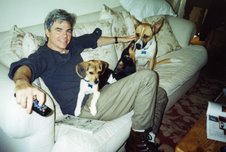
The indomitable Donna Smith has a new blog at guaranteedhealthcare.org that I'll begin checking regularly. It's got 11 contributors, and so is almost certain to have new news and comments several times a day. Most, if not all the commentators are with the California Nurses Association and the National Nurses Organizing Committee.
Nurses, whether they're aligned with the American Nurses Association or the NNOC or SEIU are foot soldiers, sergeants and include a few generals the the battle for universal health care. It's doubtful we can get there without their help. All their help. So it's sad to see the division between the unions. Shades of Hilary and Barack.
Showing posts with label Donna and Larry Smith. Show all posts
Showing posts with label Donna and Larry Smith. Show all posts
03 June 2008


23 January 2008
Donna Smith shares her story
Donna Smith shares her story at Dandelion Salad, a blog that also has a quote from Rabbi Hillel as its motto: "That which is hateful to you do not do to another ... the rest (of the Torah) is all commentary, now go study."
That sounds familiar somehow. I wonder if the health insurance industry has ever heard it. In any case, Donna and her husband Larry Smith were featured in Sicko. They're the bankrupt couple taking refuge in their daughter's storage room after they've lost their house. After working hard all their lives at jobs that offered health benefits. Single-payer supporters in Denver are very, very lucky to have them here, although we don't always know how to 1) best tap into their passion and talents, or 2) properly show them that we appreciate them.
The problem with single-payer advocacy, see, is that there's no money in it. And though Donna and Larry's work over the past year or so to move forward the cause proves that the libertarians and free-marketeers are wrong -- that people in fact are not only motivated by self-interest and profit, at the same time, there is rent to be paid.
I know that while Larry now is covered by Medicare, she is uninsured for the first time in her life. She writes about how it began, for them, at Dandelion Salad:
That sounds familiar somehow. I wonder if the health insurance industry has ever heard it. In any case, Donna and her husband Larry Smith were featured in Sicko. They're the bankrupt couple taking refuge in their daughter's storage room after they've lost their house. After working hard all their lives at jobs that offered health benefits. Single-payer supporters in Denver are very, very lucky to have them here, although we don't always know how to 1) best tap into their passion and talents, or 2) properly show them that we appreciate them.
The problem with single-payer advocacy, see, is that there's no money in it. And though Donna and Larry's work over the past year or so to move forward the cause proves that the libertarians and free-marketeers are wrong -- that people in fact are not only motivated by self-interest and profit, at the same time, there is rent to be paid.
I know that while Larry now is covered by Medicare, she is uninsured for the first time in her life. She writes about how it began, for them, at Dandelion Salad:
At the time, our insurance was good, but not great, but it did at least cover the things that he needed to have done. But like many Americans, our premiums started to creep up, and our co-pays and deductibles started to go up, and the coverage started to get worse. So just at the time when his health care needs were growing, our coverage was shrinking, and we were feeling some bad financial pressure from that.Come on, fellow Americans. We can't all move to Canada, England or France. We need to fix what's wrong with this country. Not for us so much as for our children, grandchildren and on to at least the seventh generation.
14 January 2008
Donna Smith is 47,000,001
Donna Smith blogged the other day at Michael Moore's Sicko blog that she's joined the ranks of the uninsured.
She emails today that it's not 18,300 deaths a year (estimate from the Institute of Medicine) any more. That's 50 per day, and we've all been using that figure for a long time. The number is now estimated at 22,000/year -- 137,000 from 2000-2006. Donna writes:
And so what are the rest of us left feeling? There's guilt in with the anger. I won't name the people in my family who are uninsured, even after Paul's death. But I will say that they're not gaming the system any more than Donna is. If they could afford coverage they would have it.
How many families have to have uninsured members, and how many people have to die -- from underinsurance or from being uninsured -- before enough of us say enough.
I think we've reached the tipping point.
She emails today that it's not 18,300 deaths a year (estimate from the Institute of Medicine) any more. That's 50 per day, and we've all been using that figure for a long time. The number is now estimated at 22,000/year -- 137,000 from 2000-2006. Donna writes:
I wrote the blog about joining the ranks of the uninsured. In reviewing the Jan 2008 Urban Institute report raising the estimates of the dead due to a lack of insurance, I plan to write yet another blog hoping I will not become yet another statistic in 2008: 22,001. I'd have to write that piece in advance of being added to that list --Anything for the cause, Donna, but that's a bridge too far...
And so what are the rest of us left feeling? There's guilt in with the anger. I won't name the people in my family who are uninsured, even after Paul's death. But I will say that they're not gaming the system any more than Donna is. If they could afford coverage they would have it.
How many families have to have uninsured members, and how many people have to die -- from underinsurance or from being uninsured -- before enough of us say enough.
I think we've reached the tipping point.
Edwards' health plan
Democratic Talk Radio, in publicizing the Daytona Beach paper's endorsement of John Edwards as the Democratic candidate for president, has this synopsis of the Edwards' health plan:
And thankful for it!
Donna Smith, whose story was told in Sicko, stood at this month's Health Care for All Colorado meeting to say she was uninsured for the first time in her life. Donna is doing great work to better this country, and there's no way she should be left stranded.
He wants to repeal Bush tax cuts that favor rich Americans and use the money to pay for universal health care. He would require employers to cover their employees or help finance their health insurance.How would it lead to single-payer? The idea is that the Edwards' plan would lead to single-payer because it also calls for a public buy in plan -- so that people like me could buy in to Medicare for All. That's an important element. If it could withstand the corrupting influence of the health insurance industry's lobbyists trying to cripple such a plan it could indeed show that state-guaranteed health care is quality coverage at a bargain -- instead of junk coverage at a premium, as many of us now have.
Additionally, he would lower insurance costs by creating tax credits, expanding Medicaid and coverage for children, reforming insurance laws, and containing health care costs. He would create regional markets to encourage more consumer bargaining power in buying health plans, compel broader choices among insurance plans, and cut costs for businesses offering insurance. Once these are accomplished, Edwards would require all American residents to obtain insurance. It is a bold but realistic reform for this country’s crippled market-based system. [Insurance rates would not be based on current rates because everyone would be included. Coverage would be free or subsidized for those with incomes under $100K. Edwards plan would lead to single payer]
And thankful for it!
Donna Smith, whose story was told in Sicko, stood at this month's Health Care for All Colorado meeting to say she was uninsured for the first time in her life. Donna is doing great work to better this country, and there's no way she should be left stranded.
09 January 2008

04 October 2007
Vigils and the Smiths
Last Friday's vigils, in Kansas City, Oklahoma City, Denver, Los Angeles, Pueblo, Chicago, Louisville, and Washington, D.C., brought together a couple thousand health care activists.
That story in Workers World ran a photo with Larry Smith, on the far left. Donna writes:
That story in Workers World ran a photo with Larry Smith, on the far left. Donna writes:
Check out that banner and who is walking with it!
I am so proud of my husband, with serious artery disease and pain when walking, who marched the whole route proudly holding up one end of the healtcare not warfare banner.... Three cheers for Larry.
This is a fight worth dying for -- and we will not be silenced. There is great courage being shown on this battlefield.
06 September 2007
Sen. Johnson gets it now — but do the rest?
By Donna Smith
DENVER – It was a moving scene. Sen. Tim Johnson of South Dakota returned to the U.S. Senate today, nine months after suffering a brain hemorrhage that nearly took his life.
I vividly remember that day. I was working at a contract position here in Denver when someone came out of our break room and said some Senator from South Dakota had a stroke or something. My stomach flipped. We had just moved from South Dakota weeks before, and Tim Johnson was one of my U.S. Senators.
When I arrived home that day to my daughter’s home where we were living in a small storage room, a hand-written note was waiting in her mailbox for me. It was to me from Sen. Tim Johnson. The irony of receiving that note on that day was spooky for me. The note is on his U.S. Senate note paper, and he thanked me for my efforts to be a fair reporter in western South Dakota where most media leans heavily and easily to the far right. I still have that note and will treasure it always. It wasn’t easy to report on any Democrat in western South Dakota, and it was kind of him to acknowledge that fact.
But now it is months later. I have been in Michael Moore’s SiCKO and to Cuba for health care, and Sen. Johnson and his family have been through hell and back with his brain injury. Both of our families have much yet to endure.
I listened to his statement today and marveled at his courage. How many of us would step to that microphone and do what he did and what he had obviously fought to do with every fiber of his body. Every American should take great comfort that among all the terrible falsehoods and shams we watch unfold from Washington, these few moments were very human and very American – in the best senses of both.
In part, Sen. Johnson said, “But I return to work today to this great body with a renewed spirit and a sharper focus. I better appreciate today what individuals and families go through when they face crippling hardship – whether that hardship be the consequence of catastrophic health issues, economic hardship, or lack of an opportunity to reach one’s full potential in life.
“I believe I have been given a second chance at life. I vow to take that second chance and work harder than ever to be the best I can be for my state and for my nation; to be a voice for those individuals and families who too often are ignored or forgotten; and to fight to live up to the ideals that have made this nation great. That is my focus and that is my commitment to my constituents back home in South Dakota, to the people of this great nation, and to my colleagues here in Washington.” When he finished his statement, his colleagues stood and honored him with applause, as well they should.
Then our Senate Majority Leader, Harry Reid of Nevada, spoke. In his moving tribute to his friend and fellow Democrat, Sen. Reid shared a truth that might have been lost by some but that seared at my heart and soul like a hot knife.
In praising Sen. Johnson’s doctors and acknowledging the serendipity that allowed his medical crisis to occur when and where it did, Sen. Reid inadvertently highlighted some of the very issues the rest of us out in America face today.
Reid said that if the hemorrhage had occurred one day later, Johnson might have been on an airplane bound for South Dakota. OK, that would be bad. It would have taken precious time for a plane to land and for care to reach my Senator. He might have died or had a very bad outcome indeed.
But then Reid added that if the crisis had occurred two days later, Johnson might have been on an Indian reservation. Oooh, now that’s not good. Everybody knows that having a medical emergency on one of the nation’s Indian reservations would necessarily mean pretty lousy chances for high quality trauma care or even minimal stabilization of a medical emergency.
So, my good Senators, Sen. Johnson was blessed to have his emergency in Washington, near an awesome medical facility with doctors who were top-notch and able to work with the best of the best to save his life and to save his brain so we could applaud him today.
Most Americans are not so lucky. We don’t have the insurance benefits and access to quality care that saved Sen. Johnson’s life and brain. And the kicker still is that we – the American taxpayer and voters – give our Congressional members better benefits at better prices and therefore a better chance for life than we even demand for ourselves.
I would like to hold Sen. Johnson to the words he spoke today and challenge him to work now on bringing the health care crisis in this nation forward once again in the Senate. He has a unique perspective and a unique opportunity -- Perhaps a God-given opportunity to argue that he values the health and lives of his constituents and of everyday Americans just as much as he does his own. In my heart, I know he does. Now I just need to find out if he has the courage to stand up and say it in spite of the re-election race decision looming in the not-too-distant future.
In 2004, another U.S. Senator from South Dakota offered a resolution in the Senate saying that every American should have access to health care benefits like those given to every member of Congress at a fair price. Senate Minority Leader Tom Daschle offered that resolution but was later defeated by the young Republican, John Thune, who introduced Sen. Johnson today as he returned to the Senate. Thune does not believe every American deserves the same health benefits he does.
I would like to challenge Sen. Johnson to go back to that resolution and read it again. Give it your own touches and please reintroduce it again. Let the courage and compassion you now know even more intimately exists in America guide you to bring this discussion back into the Senate before another year and another election cycle – and the deaths of 18,000 more Americans – passes. This nation needs health care reform now, please help us Sen. Johnson.
DENVER – It was a moving scene. Sen. Tim Johnson of South Dakota returned to the U.S. Senate today, nine months after suffering a brain hemorrhage that nearly took his life.
I vividly remember that day. I was working at a contract position here in Denver when someone came out of our break room and said some Senator from South Dakota had a stroke or something. My stomach flipped. We had just moved from South Dakota weeks before, and Tim Johnson was one of my U.S. Senators.
When I arrived home that day to my daughter’s home where we were living in a small storage room, a hand-written note was waiting in her mailbox for me. It was to me from Sen. Tim Johnson. The irony of receiving that note on that day was spooky for me. The note is on his U.S. Senate note paper, and he thanked me for my efforts to be a fair reporter in western South Dakota where most media leans heavily and easily to the far right. I still have that note and will treasure it always. It wasn’t easy to report on any Democrat in western South Dakota, and it was kind of him to acknowledge that fact.
But now it is months later. I have been in Michael Moore’s SiCKO and to Cuba for health care, and Sen. Johnson and his family have been through hell and back with his brain injury. Both of our families have much yet to endure.
I listened to his statement today and marveled at his courage. How many of us would step to that microphone and do what he did and what he had obviously fought to do with every fiber of his body. Every American should take great comfort that among all the terrible falsehoods and shams we watch unfold from Washington, these few moments were very human and very American – in the best senses of both.
In part, Sen. Johnson said, “But I return to work today to this great body with a renewed spirit and a sharper focus. I better appreciate today what individuals and families go through when they face crippling hardship – whether that hardship be the consequence of catastrophic health issues, economic hardship, or lack of an opportunity to reach one’s full potential in life.
“I believe I have been given a second chance at life. I vow to take that second chance and work harder than ever to be the best I can be for my state and for my nation; to be a voice for those individuals and families who too often are ignored or forgotten; and to fight to live up to the ideals that have made this nation great. That is my focus and that is my commitment to my constituents back home in South Dakota, to the people of this great nation, and to my colleagues here in Washington.” When he finished his statement, his colleagues stood and honored him with applause, as well they should.
Then our Senate Majority Leader, Harry Reid of Nevada, spoke. In his moving tribute to his friend and fellow Democrat, Sen. Reid shared a truth that might have been lost by some but that seared at my heart and soul like a hot knife.
In praising Sen. Johnson’s doctors and acknowledging the serendipity that allowed his medical crisis to occur when and where it did, Sen. Reid inadvertently highlighted some of the very issues the rest of us out in America face today.
Reid said that if the hemorrhage had occurred one day later, Johnson might have been on an airplane bound for South Dakota. OK, that would be bad. It would have taken precious time for a plane to land and for care to reach my Senator. He might have died or had a very bad outcome indeed.
But then Reid added that if the crisis had occurred two days later, Johnson might have been on an Indian reservation. Oooh, now that’s not good. Everybody knows that having a medical emergency on one of the nation’s Indian reservations would necessarily mean pretty lousy chances for high quality trauma care or even minimal stabilization of a medical emergency.
So, my good Senators, Sen. Johnson was blessed to have his emergency in Washington, near an awesome medical facility with doctors who were top-notch and able to work with the best of the best to save his life and to save his brain so we could applaud him today.
Most Americans are not so lucky. We don’t have the insurance benefits and access to quality care that saved Sen. Johnson’s life and brain. And the kicker still is that we – the American taxpayer and voters – give our Congressional members better benefits at better prices and therefore a better chance for life than we even demand for ourselves.
I would like to hold Sen. Johnson to the words he spoke today and challenge him to work now on bringing the health care crisis in this nation forward once again in the Senate. He has a unique perspective and a unique opportunity -- Perhaps a God-given opportunity to argue that he values the health and lives of his constituents and of everyday Americans just as much as he does his own. In my heart, I know he does. Now I just need to find out if he has the courage to stand up and say it in spite of the re-election race decision looming in the not-too-distant future.
In 2004, another U.S. Senator from South Dakota offered a resolution in the Senate saying that every American should have access to health care benefits like those given to every member of Congress at a fair price. Senate Minority Leader Tom Daschle offered that resolution but was later defeated by the young Republican, John Thune, who introduced Sen. Johnson today as he returned to the Senate. Thune does not believe every American deserves the same health benefits he does.
I would like to challenge Sen. Johnson to go back to that resolution and read it again. Give it your own touches and please reintroduce it again. Let the courage and compassion you now know even more intimately exists in America guide you to bring this discussion back into the Senate before another year and another election cycle – and the deaths of 18,000 more Americans – passes. This nation needs health care reform now, please help us Sen. Johnson.
31 August 2007
Colorado's Perlmutter quotes old polical boss
By Donna Smith
DENVER -- Ed Perlmutter, the U.S. Representative for House District 7 in Colorado, spoke to a group of constituents in Lakewood, Colo., on Wednesday and quoted an old political powerhouse when I asked him about health care lobbyist money as an influence on the health care reform debate.
The quote, in its cleaned-up form, turns out to be well-known:
"If you can't take their money, drink their liquor, screw their women, and then come in here the next day and vote against them, you don't belong here." -- Jesse Unruh, Speaker, California State Assembly, 1961-1969.
Known as “Big Daddy Unruh,” he also was credited with saying that money is the mother’s milk of politics. He was a powerful force on the national political scene and his political life served as a case study on “machine politics.”
It was interesting to have Unruh’s name come up in today’s session.
During the questions and answer period of Perlmutter’s meeting, I asked the freshman Congressman about making meaningful changes in health policy law and about bringing debate on health care reform to Congress. He pointed out that Rep. Diana DeGette of Colorado’s 1st Congressional District is in a powerful position a vice chair on the Energy and Commerce Committee, where health care is a major focus.
I countered that I appreciated DeGette’s potential power, but that I had concerns about the fact that her second highest contributing group in terms of her campaign financing is from health care related lobbyists. I suggested that while that doesn’t unequivocally mean that her loyalty is to those lobbyists that it does and should raise a red flag for voters like me who are concerned about health care reform.
When Perlmutter came to her defense with the Unruh quote, I was a bit taken aback. He went on to explain that because he represents a diverse district with Republicans, Democrats and Independents, he receives campaign contributions from a wide variety of individuals and interests, but that does not mean he panders to individual contributing interests. “I have faith in Diana,” he added.
Audience members added their questions about why the U.S. is the only industrialized nation without universal health care.
Another woman echoed my concerns about why those approved for Social Security Disability must then wait two years for Medicare health benefits. That seems inherently unfair when a person has been determined to be too disabled to work but then languishes without insurance or burdens other insurance plans or is unable to secure coverage at any price in today’s health insurance environment.
I told Perlmutter that Rep. John Conyers of Michigan, chair of the House Judiciary Committee, told me he would look into that too and would work to change that. The lag time between my husband Larry’s approval for Social Security Disability and his eligibility for Medicare coverage was one of the financially devastating factors that led to our bankruptcy as he fought his artery disease and I fought cancer.
All-in-all, Perlmutter said he is anxious to read all the health care reform proposals selected by Colorado’s 208 Commission and learn about the provisions of each proposal before settling on his preferred position. He pointed out that health care issues drive nearly 20 percent of the national economy and it is a complicated problem. He did not offer much support for universal health care. He didn’t speak against it.
I thanked him for his attentiveness, gave his staffer a copy of my July 17, 2007, testimony before the House Judiciary sub-committee, and told him I looked forward to meeting with him in Washington, D.C., as scheduled for Sept. 26, before the vigil on the Lincoln Memorial steps on Sept. 28 at sundown.
DENVER -- Ed Perlmutter, the U.S. Representative for House District 7 in Colorado, spoke to a group of constituents in Lakewood, Colo., on Wednesday and quoted an old political powerhouse when I asked him about health care lobbyist money as an influence on the health care reform debate.
The quote, in its cleaned-up form, turns out to be well-known:
"If you can't take their money, drink their liquor, screw their women, and then come in here the next day and vote against them, you don't belong here." -- Jesse Unruh, Speaker, California State Assembly, 1961-1969.
Known as “Big Daddy Unruh,” he also was credited with saying that money is the mother’s milk of politics. He was a powerful force on the national political scene and his political life served as a case study on “machine politics.”
It was interesting to have Unruh’s name come up in today’s session.
During the questions and answer period of Perlmutter’s meeting, I asked the freshman Congressman about making meaningful changes in health policy law and about bringing debate on health care reform to Congress. He pointed out that Rep. Diana DeGette of Colorado’s 1st Congressional District is in a powerful position a vice chair on the Energy and Commerce Committee, where health care is a major focus.
I countered that I appreciated DeGette’s potential power, but that I had concerns about the fact that her second highest contributing group in terms of her campaign financing is from health care related lobbyists. I suggested that while that doesn’t unequivocally mean that her loyalty is to those lobbyists that it does and should raise a red flag for voters like me who are concerned about health care reform.
When Perlmutter came to her defense with the Unruh quote, I was a bit taken aback. He went on to explain that because he represents a diverse district with Republicans, Democrats and Independents, he receives campaign contributions from a wide variety of individuals and interests, but that does not mean he panders to individual contributing interests. “I have faith in Diana,” he added.
Audience members added their questions about why the U.S. is the only industrialized nation without universal health care.
Another woman echoed my concerns about why those approved for Social Security Disability must then wait two years for Medicare health benefits. That seems inherently unfair when a person has been determined to be too disabled to work but then languishes without insurance or burdens other insurance plans or is unable to secure coverage at any price in today’s health insurance environment.
I told Perlmutter that Rep. John Conyers of Michigan, chair of the House Judiciary Committee, told me he would look into that too and would work to change that. The lag time between my husband Larry’s approval for Social Security Disability and his eligibility for Medicare coverage was one of the financially devastating factors that led to our bankruptcy as he fought his artery disease and I fought cancer.
All-in-all, Perlmutter said he is anxious to read all the health care reform proposals selected by Colorado’s 208 Commission and learn about the provisions of each proposal before settling on his preferred position. He pointed out that health care issues drive nearly 20 percent of the national economy and it is a complicated problem. He did not offer much support for universal health care. He didn’t speak against it.
I thanked him for his attentiveness, gave his staffer a copy of my July 17, 2007, testimony before the House Judiciary sub-committee, and told him I looked forward to meeting with him in Washington, D.C., as scheduled for Sept. 26, before the vigil on the Lincoln Memorial steps on Sept. 28 at sundown.
30 August 2007
What she has learned
Heather Bennett, a daughter of Larry and Donna Smith, was in "SiCKO" along with her parents. It was her house in Denver that the couple were headed to at the film's beginning — Heather's husband on his way to Iraq to do "some plumbing," as her son explained. Heather describes herself as "the proud daughter of Larry and Donna Smith." She's right to be proud, because her parents have done this country proud by not shutting up, not resting, but instead relentlessly leading and speaking out. They've done that despite the uncomfortable label of "health care system victim" that catapulted them into what might seem to be a catbird's seat. In fact, both Donna and Larry are more akin to being transformed into canaries in the mine.
Those of us who have been hurt by the despicable U.S. healthcare system have a duty, as Christians, Jews, Muslims, atheists, Wiccans, mothers, friends, and most of all as human beings, to speak out. The private health insurance industry will hurt you too. And if that doesn't outrage you, like the bumpersticker says, you're not paying attention. Heather's family understands. Here's Heather's column.
What I have learned...
By Heather Bennett, proud daughter of Larry and Donna Smith
My parents are featured in the Michael Moore film, "SiCKO." I am one of their six children and I am the daughter who volunteered her home when they had no place to go. I offered my home out of love and understanding that this was what I could do for them at the time. I could not erase the years of financial burden placed on them by their health care woes, but I could offer a soft place to land. For them, the opportunity to tell their story in this movie has been uplifting, dignifying and — and admittedly difficult at times. What people do not know — what people cannot see - is the private struggle behind the scenes for them and for their adult children.
It bothers me that our family did not feel comfortable sitting down and having this conversation together. Perhaps it is too idealistic to think that families do that today. Do adult children know how their parents have planned for the future? Do parents talk about health care concerns and needs? Or are we so caught up in the “me” and in keeping everything private that we don’t stop to talk about it? What is the emotion behind this? Is it fear, embarrassment or shame?
When people ask me why my parents are in the film and why I think this is so important, I answer that my parents are an example of what a couple might have to go through even though they are both working and are fully covered under multiple insurance plans. What I have come to understand over the past few weeks is that the importance of this movie is even simpler than that. It is about having the conversation and then doing something about it.
Inability to have conversations is a big part of the problem in America today. We are so careful about what we say, how we say it, when we say it and to whom we say it that often we decide it is easier not to have the conversation at all. As Michael Moore asks in this film, “Who are we?” My answer is that we are lots of individuals or small family units that are pretty uncaring and unconcerned for those around us. I would argue that Moore’s statement about the “me not we” ideology has bled past our every day dealings with the outside world, straight into our family lives. I know that I myself have learned things about the struggles they have faced by watching them give interviews or reading my mom’s eloquent words posted on a blog or a newspaper article. I also know that I feel utterly unprepared to assist as my parents age.
We live in a different time. Gone are the days that families stayed close together, generation upon generation living in the same community - taking care of each other. In our family, discussions on health care issues, financial issues and independent living issues rarely take place. What is the source of the stubbornness that stops these conversations from happening? How can we regain that connectedness?
If you are the child of an aging parent, I urge you to sit down with your parent(s) and have this discussion. Talk to them about their health. Talk to them about their healthcare. Ask the tough questions. What will happen if there is a major illness? What will happen if that illness is so debilitating that assisted living is required? Would your parent be able to survive the financial drain that a health issue can cause?
Not only do these conversations need to happen within families, but we need to take those discussions and turn them into action. Start with your State Representative, your Congressional Representative and your Senator. Where do they stand on universal health care or a single-payer plan. Have they taken money from the health care lobby? If so, why? Pledge your support for a bill in Congress - HR 676. Challenge each of the Presidential Candidates for 2008 to really explain their health care plan. The voices that rise up from our families, to each state House to the halls of Washington should be filled with anger and outrage at a system that is failing so many. For every day that we do not take action, 50 more people will die.
I wish that I had asked these questions earlier. I wish that I had been engaged in discussions with my parents on an entirely different level. In America, we must get back to a focus on “we”. It starts with asking the questions and planning for the future. Parents must feel no shame or loss of dignity in telling their children what they might need to survive a major illness. Children need to be prepared before something happens.
I urge you to see this movie - parents and children together. Start the conversation and then take action. When you start the conversation, you may be surprised at what you learn. I know I have been.
Those of us who have been hurt by the despicable U.S. healthcare system have a duty, as Christians, Jews, Muslims, atheists, Wiccans, mothers, friends, and most of all as human beings, to speak out. The private health insurance industry will hurt you too. And if that doesn't outrage you, like the bumpersticker says, you're not paying attention. Heather's family understands. Here's Heather's column.
What I have learned...
By Heather Bennett, proud daughter of Larry and Donna Smith
My parents are featured in the Michael Moore film, "SiCKO." I am one of their six children and I am the daughter who volunteered her home when they had no place to go. I offered my home out of love and understanding that this was what I could do for them at the time. I could not erase the years of financial burden placed on them by their health care woes, but I could offer a soft place to land. For them, the opportunity to tell their story in this movie has been uplifting, dignifying and — and admittedly difficult at times. What people do not know — what people cannot see - is the private struggle behind the scenes for them and for their adult children.
It bothers me that our family did not feel comfortable sitting down and having this conversation together. Perhaps it is too idealistic to think that families do that today. Do adult children know how their parents have planned for the future? Do parents talk about health care concerns and needs? Or are we so caught up in the “me” and in keeping everything private that we don’t stop to talk about it? What is the emotion behind this? Is it fear, embarrassment or shame?
When people ask me why my parents are in the film and why I think this is so important, I answer that my parents are an example of what a couple might have to go through even though they are both working and are fully covered under multiple insurance plans. What I have come to understand over the past few weeks is that the importance of this movie is even simpler than that. It is about having the conversation and then doing something about it.
Inability to have conversations is a big part of the problem in America today. We are so careful about what we say, how we say it, when we say it and to whom we say it that often we decide it is easier not to have the conversation at all. As Michael Moore asks in this film, “Who are we?” My answer is that we are lots of individuals or small family units that are pretty uncaring and unconcerned for those around us. I would argue that Moore’s statement about the “me not we” ideology has bled past our every day dealings with the outside world, straight into our family lives. I know that I myself have learned things about the struggles they have faced by watching them give interviews or reading my mom’s eloquent words posted on a blog or a newspaper article. I also know that I feel utterly unprepared to assist as my parents age.
We live in a different time. Gone are the days that families stayed close together, generation upon generation living in the same community - taking care of each other. In our family, discussions on health care issues, financial issues and independent living issues rarely take place. What is the source of the stubbornness that stops these conversations from happening? How can we regain that connectedness?
If you are the child of an aging parent, I urge you to sit down with your parent(s) and have this discussion. Talk to them about their health. Talk to them about their healthcare. Ask the tough questions. What will happen if there is a major illness? What will happen if that illness is so debilitating that assisted living is required? Would your parent be able to survive the financial drain that a health issue can cause?
Not only do these conversations need to happen within families, but we need to take those discussions and turn them into action. Start with your State Representative, your Congressional Representative and your Senator. Where do they stand on universal health care or a single-payer plan. Have they taken money from the health care lobby? If so, why? Pledge your support for a bill in Congress - HR 676. Challenge each of the Presidential Candidates for 2008 to really explain their health care plan. The voices that rise up from our families, to each state House to the halls of Washington should be filled with anger and outrage at a system that is failing so many. For every day that we do not take action, 50 more people will die.
I wish that I had asked these questions earlier. I wish that I had been engaged in discussions with my parents on an entirely different level. In America, we must get back to a focus on “we”. It starts with asking the questions and planning for the future. Parents must feel no shame or loss of dignity in telling their children what they might need to survive a major illness. Children need to be prepared before something happens.
I urge you to see this movie - parents and children together. Start the conversation and then take action. When you start the conversation, you may be surprised at what you learn. I know I have been.
20 August 2007
Jim Spencer reappears!
The Denver Post's fine columnist Jim Spencer was given the boot earlier this year — a matter of rationing liberal views, evidently.
We all missed him — and so I was pleased to see his byline on this column: "In the Matter of Health Care Versus Baloney" at Colorado Confidential, Colorado's preeminent progressive blog.
Spencer, as always, did his homework responding to the Rocky Mountain News's scurrilous attack on Health Care for All Colorado's proposal to the Blue Ribbon Commission for Health Care Reform. The title of that RMN piece? "Single-payer Baloney."
They got just about everything wrong. No. They got everything wrong.
Unlike the Rocky, which didn't evidently do any research, no quotes, no references, and they certainly didn't get in touch with us or the Colorado Nurses, Jim quoted Donna Smith:
We all missed him — and so I was pleased to see his byline on this column: "In the Matter of Health Care Versus Baloney" at Colorado Confidential, Colorado's preeminent progressive blog.
Spencer, as always, did his homework responding to the Rocky Mountain News's scurrilous attack on Health Care for All Colorado's proposal to the Blue Ribbon Commission for Health Care Reform. The title of that RMN piece? "Single-payer Baloney."
They got just about everything wrong. No. They got everything wrong.
Unlike the Rocky, which didn't evidently do any research, no quotes, no references, and they certainly didn't get in touch with us or the Colorado Nurses, Jim quoted Donna Smith:
But on the business side, the U.S. system “doesn’t even make economic sense,” said Donna Smith of Aurora, whose family health problems forced her and her husband to declare bankruptcy. “Single payer would lower the burden on American businesses.”The Rocky did print Fran Ricker's and my rebuttal on Saturday — which was good of them, since it's a combined circulation that day of both Rocky subscribers and Denver Post subscribers.
Smith and her husband, Larry, appear in Michael Moore’s documentary “SICKO,” which lambastes the U.S. health care model. Smith testified before Congress in July about the inability of many Americans to afford health care. She just started a group called American Patients for Universal Health Care.
If you’re worried that Smith isn’t objective because she has a dog in this fight, then check with Colorado’s own financial consultant on health care reform. The Lewin Group has issued a preliminary finding that cumulatively, a single payer health system will save Colorado money on health care.
16 August 2007
Faith and single-payer healthcare
Donna Smith, the editor who with her husband Larry was featured in "Sicko," has a new piece in The Black Commentator. It's Part 26 (!) in their series on single-payer healthcare. Donna writes:
It's a great piece, ending with a call to action: write or call or set up a visit with your representative to thank them for co-sponsoring HR 676 if they have, or to urge them to do so if they haven't.
Go to Healthcare-NOW to see where your legislator stands.
Is universal health care the right and moral thing to do? Are we who reside in faith communities within our churches and our communities called to action on this issue? Will we cast off all the things we have accumulated and follow what we have been taught to follow, in the face of this battle on behalf of those who cannot join the fray? Or will the vast majority of us remain silent, as we have over the past 30 years, giving our power and our presence over to those who express only the narrowest of Godly intentions?Donna also writes that "This health crisis cannot be prayed away."
It's a great piece, ending with a call to action: write or call or set up a visit with your representative to thank them for co-sponsoring HR 676 if they have, or to urge them to do so if they haven't.
Go to Healthcare-NOW to see where your legislator stands.
25 June 2007
Donna Smith calls for action
 Michael Huttner of ProgressNow, Evi Klett of the Progressive Democrats of America, and I spoke to the crowd first, and then Nathan Wilkes spoke, warning the crowd that those of them who thought they had good healthcare coverage probably were mistaken. He had thought the same before getting the news that his son Thomas had been diagnosed with hemophilia. Health insurance companies have been trying to get rid of the Wilkes family ever since. Thomas, evidently is nothing more than collateral damage when it comes to maximizing shareholder profit. Nathan introduced Elinor Christiansen, MD, the president of Health Care for All Colorado.
 Elinor spoke eloquently without notes: She's been fighting this battle a long time.
Next to the microphone was Donna Smith, one of Health Care for All Colorado's newest members. She emailed me her remarks, and I'll simply share them rather than try to condense:
Remarks by Donna Smith, Aurora, Colo.She then introduced her "SiCKO commander-in-chief," Michael Moore.
DENVER -- My name is Donna Smith. Today I stand here as a member of a very exclusive club. I am one of only a few Americans featured in Michael Moore’s new movie, SiCKO. And I am part of an even more exclusive group of just eight Americans who traveled to Cuba with Michael to receive medical care.
Trust me, as much as I’ve grown to respect and enjoy Michael Moore and his crew, this club that isn’t one for which you want to qualify. Each of us in the film has lost much at the hands of the American private health care system. Some lost everything they owned after a lifetime of hard work – like we did; and some lost their lives.
The stories you will see on the screen during SiCKO represent tens of thousands of other American tragedies. As we stand here today, 50 Americans will die today without the necessary care they needed simply because they couldn’t afford it.
But you and I together are in another not-so-exclusive club with more than 250 million fellow Americans, we are the health insurance card-carrying club – we are Coloradoans, we are Americans – we are brothers and sisters, mothers and fathers, neighbors and friends at great risk due to the lack of universal health care.
Having health insurance no longer means having peace of mind. If you get sick and you are insured you may find yourself underinsured or worse – unable to get necessary care. You may have premiums rising so high that you can no longer afford both housing and health insurance. You may have deductibles and co-pays that effectively and efficiently squeeze you away from seeking care. You may have collectors pursuing medical debt hound you to the point of garnishment and humiliation – as we did. You may have an employer that no longer wants you covered by the group health insurance plan with rising premiums and huge deductibles. And you may not know these things until in the grip of a health care crisis with no options and no ability to dig out.
But our club is a powerful club too, my friends. We have what we need to change this broken health care system. We have voices to speak up, we have pens and computers with which to write and we have the ballot box in which we will send the clearest statement of our membership creed:
No Coloradoan, no American, should ever want again for basic health care. No American family should face financial ruin because someone gets sick. And certainly not one more American should die because he or she was denied treatment. Universal, single-payer health care is within our reach and it our duty and responsibility to push for it.
Though many of our elected officials will scatter like bugs when they are forced to take a stand on this issue or heaven forbid stand in unity with Michael Moore, it is up to you and me to hold them steady to the cause. They must fear our voices and the loss of our votes more than they fear the loss of health care lobby money for their campaigns or the threats of negative ads against them if they do not tow the private health care line.
It is no longer enough for our leaders to protect life only while it is in the womb. To be cared for when we are sick is a basic human need and a basic human right.
Forty years ago, in April of 1967, speaking at the Riverside Church in New York, Dr. Martin Luther King, Jr., said,” Of all the forms of injustice, inequality in health care is the most shocking and inhumane.”
Reach deep into your minds and hearts Colorado. Are we willing to be shocking and inhumane any longer?
Half measures will not do. Universal, free health care must become reality.
On the day I left Denver to meet up with the Michael Moore production crew in Miami, the front page of the Rocky Mountain News had a story about Anna Nicole Smith’s body and where it might end up. Page one, my friends. On page 14, there was a much smaller story about Nathan Wilkes and his family right here in Colorado. Though fully insured, they are living the same healthcare nightmare faced by so many of us today.
Earlier this week on a movie screen in the middle of Manhattan, my dignity and my voice began to return. No longer shamed by my inability to stay financially afloat in a sea of health care debt, I will not rest until every American has access to free, universal health care.
My husband Larry and I rode from Manhattan through Philadelphia and into Washington, D.C., on a bus dubbed the SiCKO bus with nurses from throughout the country led by the brave and dedicated nurses from the California Nurses Association. We had nurses with us from New Jersey, New York, Pennsylvania, Massachusetts, my home state of Illinois and of course from California. Everywhere we stopped, we were met with cheers and support for the nurses and their message: Universal health care now for all Americans.
And now I’d like to introduce to you the man who restored my dignity in SiCKO and who fights for justice in health care throughout this land. He is an Academy Award winning and Cannes Film Festival winning filmmaker, and an American patriot in the truest sense. He is also here to inspire us to keep up the fight right here in Colorado.
11 June 2007
It really is Sicko, but a package arrived today
Donna Smith, who describes herself as "one proud American appearing in Michael Moore’s newest film, Sicko," wrote up this story about the time of her 31st wedding anniversary earlier this month. She and her husband Larry lost their home after both becoming ill around the same time. They're scraping by these days, walking wounded with him, after three heart bypasses, arguing the need for him to go back to work and her arguing that he mustn't. Donna, a newspaper editor who understands how unlikely it is that she'll ever work in that capacity again since taking up the cause of healthcare justice, wrote this up last week. Sicko opens June 29. Go see it that first weekend.
A package arrived today at my home. It was a welcome sight. It came from a friend, a SiCKO soul mate, who knows what it is to go without medications so that others might have theirs and because there just isn’t enough cash to go around.
Over the past several weeks, I have been weaning myself off of one of my most important medications, my Advair. It is the asthma inhaler that helps my lungs stay open and free from asthma attacks. And I have taken it for almost four years.
Advair is expensive. But even as the doctors in Cuba, where we went with Michael Moore, were taking me off of five other medications, including the beta blocker they said no asthmatic should ever take, they all agreed, “Take your Advair. It is perfect for you. It makes you better.”
But the doctors in Cuba don’t understand. No matter how perfect a medicine or a treatment may be for an American with health issues, unless that American has the cash to pay for the needed item or care, their body will go without.
I first started on Advair four years ago after a debilitating obstructive asthma attack that landed me in the hospital for three days. The pulmonary doctor who saw me then thought I might be helped by the inhaler, and he was right. My lung function dramatically improved with the medicine and my need for the short-acting inhalers to stop acute asthma attacks dropped to almost nil.
It seemed that within a few short months, my lung status was changed from one I feared every time I was outdoors in the cold or near one of my asthma triggers or – heaven forbid – I caught a cold, to one of a nearly normal person. Advair was a miracle for me.
But it' s pricy. Even at the local mega-discount chain pharmacy, Advair in my strength can be $200 a month.
I have insurance, but that doesn’t solve the problem. That same pulmonologist that first prescribed my Advair quit seeing me because we declared bankruptcy in 2004, and his practice group wanted cash up front from me (and then they suggested I submit my own insurance claim). I was devastated since my insurance carrier had always paid handsomely for my care and the only amount this clinic in Rapid City, SD, lost was $200 that had to be listed in the bankruptcy action. So, I couldn’t see him anymore.
I waited until spring of 2007 in Havana, Cuba, to see a lung specialist again. I never got to see an allergist in South Dakota either. The only one my family doc would refer me to was in the same practice group with that “no-dirty-bankrupt-persons” sign on the door.
But over the years, I did manage to talk my way to a continued Advair prescription from whichever doctor I was seeing at the moment. I knew it was helping me, and I knew I had to take it.
Then the bottom fell out of our lives. Insurance premiums topped $600 monthly, and something had to give. Though I was deeply grateful to be participating in the Michael Moore project, that wasn’t going to fix the problems that made me perfect fodder for the film.
When I returned from Cuba, the Advair ran out. My new insurance has a deductible to meet, and it so happened that my Advair was the medication next up on the refill queue for us. My husband takes eight prescription medications for his coronary artery disease, peripheral artery disease, and other conditions. Though I had come off several meds in Cuba, I still needed four – including my expensive Advair.
One local doctor gave me a sample that lasted two weeks, and then offered a sample of a lesser drug. I took it. But as the days wore on, I could feel my lungs starting to tighten again. The pain I had lived without returned. Climbing stairs once again became more taxing; my sleep issues worsened. My asthma was back.
And the shame is all there too. How do I tell the world that I am still a failure – SiCKO “star” and all. I cannot even manage to spring loose $200 to meet my deductible and get my medicine.
The rent, the utilities, the food, the gas for me to get to work, the insurance, the loan payments… my husband’s medications… all must be paid. And my lungs will keep hurting, and all the ground I gained over the past four years will be lost for the lack of $200.
Ask for help, you say. Borrow the money, you say. Get another job. I did but it isn’t helping enough just yet. I’m sure it will if I work a little harder. Stop whining. Buck up, buck up… this is America where if you want it bad enough you can do it.
But how do you admit that no one close to you wants to hear any more health-related trauma? They’d rather buy you dinner or almost anything else than hear you need help to buy Advair.
Grown children might send you a Mother’s Day card, but do not want to help with a prescription. And it isn’t cruelty, it’s denial. Denial that the problem with health care really is as bad as it is in America and denial that your mother is a failure at solving it.
Folks want to hear about the potential fame and notoriety of a film part. What they cannot stand to face is the reality of the situation for me and for many Americans. Thousands and thousands of people will go to bed without their meds tonight.
Being a part of a film with so much potential did not adjust reality for me – not this part of the reality. It’s going to take work and compassion and intelligence to do that over time. Whether a new president will actually tackle the issue is by no means a given, and no one has yet explained to me in a way I can comprehend why the current Congress, including so many of these presidential candidates, cannot and will not act on behalf of the Americans like me who are sinking fast.
But then a package arrived today. My SiCKO sister, more a sister than she can know, sends me the Advair samples she can no longer take. This woman, this friend, stood at ground zero on 9/11. She was made sick by it… very, very sick. Her lungs hurt as mine do, but Advair doesn’t relieve her pain. So she gave it to me.
We also lack the political and moral will to care for her – and thousands of her fellow 9/11 workers. We make them beg for benefits and fight at hearings planned months into the distance. They were our heroes held up to the world yet now they apparently are our albatrosses. Dead weight. It is incomprehensible to me that one of our elected officials does not simply stand up and honor these people by demanding they be cared for compassionately and completely. No explanation suffices for the system failing my SiCKO sister.
The health care system that brought about this chain of events is making many of us sicker than we need to be, and it is costing us so very much.
I will spend, with my SiCKO sister, the next however-long-it-takes fighting for change. The health care system in this nation must change. And it should start today, not with the next presidential election. No, Senators Obama and Clinton – and all of the rest of you — not by the end of your first terms. That’s not good enough.
But for now, I cradle my gift given with only love and complete understanding for what I am going through. Tonight I will inhale my Advair, and a few weeks from now I will breathe easier again.
A package arrived today at my home. It was a welcome sight. It came from a friend, a SiCKO soul mate, who knows what it is to go without medications so that others might have theirs and because there just isn’t enough cash to go around.
Over the past several weeks, I have been weaning myself off of one of my most important medications, my Advair. It is the asthma inhaler that helps my lungs stay open and free from asthma attacks. And I have taken it for almost four years.
Advair is expensive. But even as the doctors in Cuba, where we went with Michael Moore, were taking me off of five other medications, including the beta blocker they said no asthmatic should ever take, they all agreed, “Take your Advair. It is perfect for you. It makes you better.”
But the doctors in Cuba don’t understand. No matter how perfect a medicine or a treatment may be for an American with health issues, unless that American has the cash to pay for the needed item or care, their body will go without.
I first started on Advair four years ago after a debilitating obstructive asthma attack that landed me in the hospital for three days. The pulmonary doctor who saw me then thought I might be helped by the inhaler, and he was right. My lung function dramatically improved with the medicine and my need for the short-acting inhalers to stop acute asthma attacks dropped to almost nil.
It seemed that within a few short months, my lung status was changed from one I feared every time I was outdoors in the cold or near one of my asthma triggers or – heaven forbid – I caught a cold, to one of a nearly normal person. Advair was a miracle for me.
But it' s pricy. Even at the local mega-discount chain pharmacy, Advair in my strength can be $200 a month.
I have insurance, but that doesn’t solve the problem. That same pulmonologist that first prescribed my Advair quit seeing me because we declared bankruptcy in 2004, and his practice group wanted cash up front from me (and then they suggested I submit my own insurance claim). I was devastated since my insurance carrier had always paid handsomely for my care and the only amount this clinic in Rapid City, SD, lost was $200 that had to be listed in the bankruptcy action. So, I couldn’t see him anymore.
I waited until spring of 2007 in Havana, Cuba, to see a lung specialist again. I never got to see an allergist in South Dakota either. The only one my family doc would refer me to was in the same practice group with that “no-dirty-bankrupt-persons” sign on the door.
But over the years, I did manage to talk my way to a continued Advair prescription from whichever doctor I was seeing at the moment. I knew it was helping me, and I knew I had to take it.
Then the bottom fell out of our lives. Insurance premiums topped $600 monthly, and something had to give. Though I was deeply grateful to be participating in the Michael Moore project, that wasn’t going to fix the problems that made me perfect fodder for the film.
When I returned from Cuba, the Advair ran out. My new insurance has a deductible to meet, and it so happened that my Advair was the medication next up on the refill queue for us. My husband takes eight prescription medications for his coronary artery disease, peripheral artery disease, and other conditions. Though I had come off several meds in Cuba, I still needed four – including my expensive Advair.
One local doctor gave me a sample that lasted two weeks, and then offered a sample of a lesser drug. I took it. But as the days wore on, I could feel my lungs starting to tighten again. The pain I had lived without returned. Climbing stairs once again became more taxing; my sleep issues worsened. My asthma was back.
And the shame is all there too. How do I tell the world that I am still a failure – SiCKO “star” and all. I cannot even manage to spring loose $200 to meet my deductible and get my medicine.
The rent, the utilities, the food, the gas for me to get to work, the insurance, the loan payments… my husband’s medications… all must be paid. And my lungs will keep hurting, and all the ground I gained over the past four years will be lost for the lack of $200.
Ask for help, you say. Borrow the money, you say. Get another job. I did but it isn’t helping enough just yet. I’m sure it will if I work a little harder. Stop whining. Buck up, buck up… this is America where if you want it bad enough you can do it.
But how do you admit that no one close to you wants to hear any more health-related trauma? They’d rather buy you dinner or almost anything else than hear you need help to buy Advair.
Grown children might send you a Mother’s Day card, but do not want to help with a prescription. And it isn’t cruelty, it’s denial. Denial that the problem with health care really is as bad as it is in America and denial that your mother is a failure at solving it.
Folks want to hear about the potential fame and notoriety of a film part. What they cannot stand to face is the reality of the situation for me and for many Americans. Thousands and thousands of people will go to bed without their meds tonight.
Being a part of a film with so much potential did not adjust reality for me – not this part of the reality. It’s going to take work and compassion and intelligence to do that over time. Whether a new president will actually tackle the issue is by no means a given, and no one has yet explained to me in a way I can comprehend why the current Congress, including so many of these presidential candidates, cannot and will not act on behalf of the Americans like me who are sinking fast.
But then a package arrived today. My SiCKO sister, more a sister than she can know, sends me the Advair samples she can no longer take. This woman, this friend, stood at ground zero on 9/11. She was made sick by it… very, very sick. Her lungs hurt as mine do, but Advair doesn’t relieve her pain. So she gave it to me.
We also lack the political and moral will to care for her – and thousands of her fellow 9/11 workers. We make them beg for benefits and fight at hearings planned months into the distance. They were our heroes held up to the world yet now they apparently are our albatrosses. Dead weight. It is incomprehensible to me that one of our elected officials does not simply stand up and honor these people by demanding they be cared for compassionately and completely. No explanation suffices for the system failing my SiCKO sister.
The health care system that brought about this chain of events is making many of us sicker than we need to be, and it is costing us so very much.
I will spend, with my SiCKO sister, the next however-long-it-takes fighting for change. The health care system in this nation must change. And it should start today, not with the next presidential election. No, Senators Obama and Clinton – and all of the rest of you — not by the end of your first terms. That’s not good enough.
But for now, I cradle my gift given with only love and complete understanding for what I am going through. Tonight I will inhale my Advair, and a few weeks from now I will breathe easier again.
08 June 2007
Christianized medicine
Donna Smith, who appears in Michael Moore's new film Sicko and who is very much a Christian, sent along these quotes from the end of a story in the Detroit News.
Here's the difference:
In Matthew 25:31-46, Jesus told his disciples that those who fed the hungry and gave water to the thirsty, those who clothed the naked and visited the sick or in prison will go to heaven. “I tell you the truth, whatever you did to one of the least of these brothers of mine, you did to me,” said Jesus.
Those who don't will go to hell: “Depart from me, you who are cursed,” he begins. “… I was a stranger, and you did not invite me in, I needed clothes, and you did not clothe me, I was sick and in prison and you did not look after me.”
Now Matthew 28: “Go, therefore, and make disciples of all nations, baptizing them in the name of the Father, and of the Son, and of the Holy Spirit, teaching them to observe all that I have commanded you.”

I wrote last year in the Catholic Sentinel about what a difference that makes in real life:
That great photo, by the way, is from Rick D'Elia, who has recently emailed from Rwanda.
"This film comes from a spiritual place," Moore says, "so I wanted to go to the headquarters of the sisters who taught me in my early years. They had a profound impact on me."Michael, according to Maryknoll Father Charlie Dittmeier, is probably a Matthew 25 Christian — a verrry different species than a Matthew 28 Christian.
The idea that it's about "the we, not the me," came from the nuns. "Instead of calling it 'socialized medicine,' it should be called 'Christianized medicine.'"
"This was one of the ground rules that was laid down by Jesus. He said, 'I'm going to ask you a bunch of questions when you get to the pearly gates. When I was hungry did you feed me? When I was homeless, did you give me shelter? When I was sick, did you take care of me? And if you didn't do these things, and you didn't do these for the least of my people, then I'm going to have to say that you can't come in the big house.'"
Here's the difference:
In Matthew 25:31-46, Jesus told his disciples that those who fed the hungry and gave water to the thirsty, those who clothed the naked and visited the sick or in prison will go to heaven. “I tell you the truth, whatever you did to one of the least of these brothers of mine, you did to me,” said Jesus.
Those who don't will go to hell: “Depart from me, you who are cursed,” he begins. “… I was a stranger, and you did not invite me in, I needed clothes, and you did not clothe me, I was sick and in prison and you did not look after me.”
Now Matthew 28: “Go, therefore, and make disciples of all nations, baptizing them in the name of the Father, and of the Son, and of the Holy Spirit, teaching them to observe all that I have commanded you.”

I wrote last year in the Catholic Sentinel about what a difference that makes in real life:
PHNOM PENH, Cambodia — The middle-aged woman waiting for a connecting flight is an Evangelical Christian, proud of what her church is doing in Cambodia. There is an orphanage for 30 children and a school for more than 200. But most important, they were building churches so fast that she couldn’t keep track of them: A dozen just this year.Bless that woman for giving me such a great lead.
The Catholic Church, she said, doesn’t have much of a presence in Cambodia.
How about Catholic Relief Services, Caritas, the Jesuits, the Maryknollers, the PIME fathers and all the other Catholic NGOs and orders?
She shook her head. “All they do is help people,” she said. “They’re not really spreading the Good News.”
That great photo, by the way, is from Rick D'Elia, who has recently emailed from Rwanda.
01 June 2007
Colorado woman's cameo in Sicko
 Donna Smith, a journalist faced with crippling healthcare costs despite being insured, was one of eight Americans who traveled with Michael Moore to Cuba in March for treatment there. Moore filmed the trip for his documentary Sicko, which opens later this month. Donna writes movingly about the experience at Huffington Post and at Healthcare Now.
 At Moore's site, there's this introduction to Smith in an AP story about the recent New York screening of Sicko. "Donna Smith, in from Denver with her husband, Larry, was in tears when she spoke. The film opens with their painful story: Plagued with health problems, they were forced to sell their home and move into the storage room of their daughter's house because they couldn't cope with health costs, even though they were insured.
"'Health care is an embarrassment to our nation,' Donna told Moore. 'You give dignity to every American in this film.'"
At the heart of Donna's story is the psychic trauma that our healthcare system inflicts on people like her — people, she says, "who play by the rules" (she's always had health insurance) but are still victimized by our system. From the Healthcare Now piece:
As I walked to where I would stay in the hospital [in Cuba] for my evaluation, I felt something deeply painful beginning to surface. I felt my gut tighten and even a stab of pain in my chest as I flashed over all the incidents of the past 20 years when I struggled to get health care and when I was made to feel disgusting. My brain swirled with images of payment plans (some signed literally at surgical bedside), applications for community benefits, rising health insurance deductions, angry health providers dunning us for small balances not covered by insurance (though many had been paid thousands already), and countless other humiliations in spite of the fact that I had never allowed my family to go without health insurance...Donna is articulate and passionate about this issue — she knows first hand that our system is so unjust that it's fair to call it barbaric. It certainly has no relationship to the Christianity that Americans think of as guiding this country.
Over the next few days, I began to absorb the healing power of this form of medicine. Just the knowledge that each human being is valuable, that each life is sacred and worthy, began to heal so much of the sickness of my spirit that also caused some of the sickness of my body. And so my journey into a new life was started. For perhaps the first time in my life, I felt that my Creator had given a glimpse of unconditional love and peace.
I always find myself admiring people like Donna for sticking with their faith despite the evidence arrayed against it — mostly evidence about how miserably most individual "Christians" and "Christian nations" fail to live up to their ideals. She's right there with Bill Moyers in terms of being a better example of what a Christian should be.
Donna's bout with cancer together with her husband's many medical problems forced the two to leave South Dakota, where she had edited a small daily newspaper. She's in suburban Denver now, still struggling with healthcare costs — although in better shape than she had been before Cuba.
I spoke with her tonight, and she says that she arrived in Cuba on nine medications, and left on only four — and feeling much better.
One of the meds she's still dependent on is an asthma inhaler costing $175 — each. Her insurance will pay for it — after she spends enough to cover her deductible. The Smiths' real worries, however, are regarding her husband, Larry, who was too ill to travel safely to Cuba. Donna said that her sense that it should have been Larry there getting treatment was the hard part of her trip to Cuba.
And Moore's fact-checkers. They were tough to take as well. Contrary to mainstream media's depiction of Moore being more interested in telling a good story than he is in sticking to the facts, Donna said that his staff was relentless when it came to insisting on documentation for everything that she and Larry told them about their story.
I'm sorry that the Smiths have had their lives turned upside down by the idiocies of our system. I'm thankful that she's taking this experience and speaking out to make the world a better place. "God gave us brains so we could use them," she told me tonight.
Hope so.
Subscribe to:
Posts (Atom)